Digital for entrepreneurs: website, marketing, e-commerce and AI to grow
I work online for a living. I build and run brands, I sell on marketplaces, I build websites and small tools, and lately I do a growing part of all of it with the help of AI. I am an entrepreneur, so I know from the inside what other entrepreneurs actually need, which is rarely more theory and usually a clear idea of what to do first. That is the perspective this guide is written from.
The reason I am writing it is simple. Most business owners I talk to know the digital world matters but feel lost in it, buried under tools, buzzwords, and people selling courses. So here is the honest map, the four levers that actually move a business online, where artificial intelligence genuinely changes the game, and how to start without wasting money. No hype, just what works.
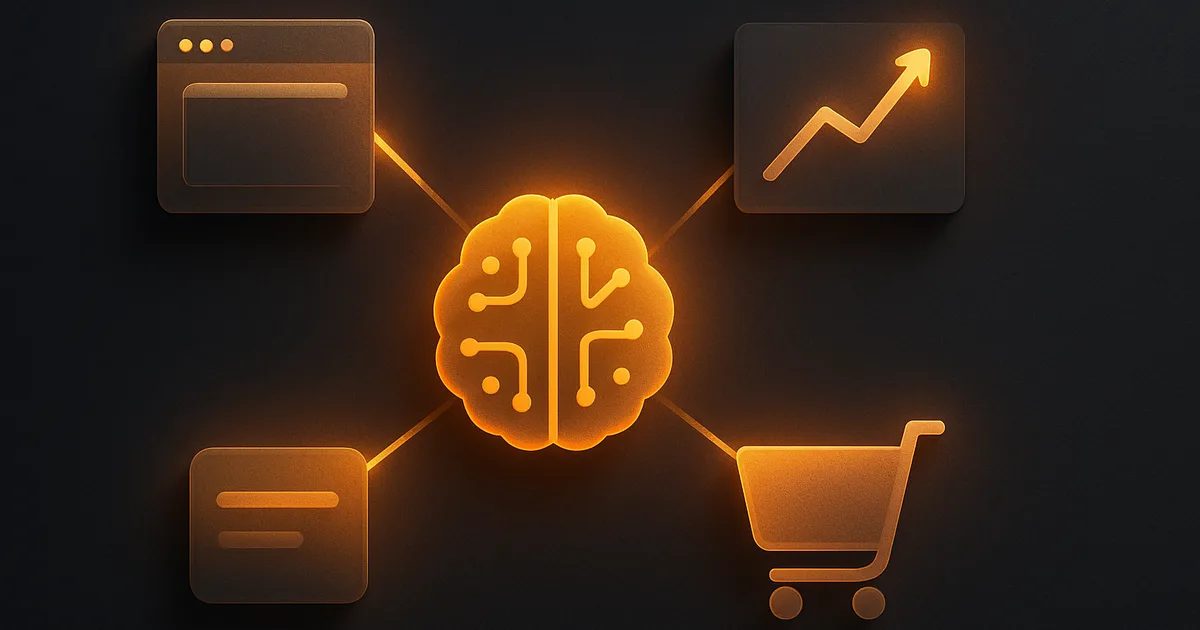
Growing a business online comes down to four levers: a website you own, digital marketing that brings the right people to it, an e-commerce channel if you sell products, and AI used as an accelerator across all three. You do not need all of them at once. You need the one your business is most missing, done well, and the discipline to ignore the noise around the rest.
Why no business can ignore digital now (and why that is good news)
For a long time, being visible and selling beyond your own town required money and connections most small businesses did not have. You needed an agency, a budget, a developer, a warehouse. That barrier is the thing that has quietly collapsed, and it is the most important shift of the last few years.
I say this from experience. I started from San Severo, a town in Puglia in the south of Italy, not from a tech hub or a big city. And yet the work I do reaches customers and markets all over the world, because the tools that used to be locked behind big budgets are now a few clicks away. A solo founder today has access to the same advertising platforms, the same global marketplaces, and the same AI that large companies use. The playing field is not perfectly level, but it is closer than it has ever been.
That is the good news hiding inside all the noise. The barrier is no longer access, it is knowing what to do with the access. The businesses that win now are not the ones with the biggest budgets, they are the ones that pick the right lever and learn to pull it well. The rest of this guide is about which lever, and how.
There is a flip side worth naming honestly. Because the tools are now accessible to everyone, simply being online is no longer a differentiator, it is the baseline. Your customers already compare you to businesses that show up well online, even ones that are bigger or further away than you. So the real question is not whether to be digital, that ship has sailed, but how to do the few things that genuinely matter well enough to stand out from everyone else who also has access. That is a far more answerable question, and it is the one the rest of this guide is built around.
The four levers of digital (and where AI changes everything)
Almost everything in digital, under the jargon, comes down to four things working together. I think of them as levers because you rarely pull all four at once. You find the one that is holding your business back and you focus there.
A website you actually own. Social profiles are rented ground, the platform sets the rules and can change them overnight. Your website is the one digital asset you own outright, and it is where a serious buyer goes to decide whether to trust you. It does not need to be elaborate. It needs to load fast, work on a phone, and say in the first three seconds what you do and why someone should contact you. The big change here is that you no longer need to be a developer or hire one to get started. With AI you can describe what you want in plain language and build a clean, working site far faster than was possible even two years ago. I build sites and small tools this way myself, and it has turned a months-long, expensive project into something a motivated owner can start in a weekend.
Digital marketing that brings the right people in. A perfect website nobody visits is a shop in the desert. Marketing is how the right people find you, through search, content, and advertising. The goal is not vanity numbers, it is qualified attention, people who actually might buy. AI has changed the daily work of marketing more than almost any other area. It drafts content, suggests keywords, writes and tests ad variations, and analyses what is working in minutes instead of days. It does not replace the strategy, but it removes most of the grunt work that used to make marketing slow and expensive for a small team.
An e-commerce channel, if you sell products. If you sell physical or digital products, selling online multiplies your reach beyond anyone who can physically walk in. There are two broad routes, your own online store, which you control fully, and marketplaces like Amazon, where the audience is already there but the rules and the competition are theirs. Each has trade-offs, and the right answer depends on your product and your margins. This is the area I have gone deepest in over the years, and if it is your lever, I have written separately on the costs of selling on a marketplace, on fulfilment, and on finding a product worth selling. The principle that matters here is to start with one channel and do it properly rather than spreading yourself thin across all of them.
AI as the accelerator across all three. This is the lever that is also a multiplier. AI is its own area, but its real power is how it speeds up the other three. It helps you build the website, run the marketing, and manage the e-commerce, all faster and with a smaller team. Treating AI as a separate gadget you bolt on misses the point. The businesses getting real value are weaving it into the work they already do, one task at a time, until the things that used to take a day take an hour.
Where do you actually stand on these four? That is worth being honest about, because the answer tells you where to spend your next month. The tool below is built for exactly that.
The shape of your digital
Answer the four quick questions below. The chart draws your digital shape, and the smallest point, the part of the shape that caves in, is usually where a little focused work pays back the most.
The shape of your digital
Answer four quick questions. The chart draws your digital shape and points to where to start.
1. How do customers find you online?
2. What web presence does your business have?
3. How do you sell your products or services?
4. How much do you use AI in your work?
Answer the questions to see where to focus first.
A quick self-assessment to see where you are most exposed, not a precise audit. The smallest point on the chart is usually where a little focused work pays back the most.
How I use AI in each lever, concretely
Because AI is the lever people most want real examples of, here is how it actually shows up in my own week, lever by lever. None of it is futuristic. It is just where the hours go now, and why a small team can suddenly keep up with a big one.
On the website side, I describe the page I want in plain language and have AI scaffold the layout, the copy, and the structure, then I refine it by hand. What used to mean a brief, a quote, and weeks of back and forth with a developer is now a first working version in an afternoon. I still make every decision about what the page should say and who it is for, the AI just removes the slow part of turning that decision into something real. The same goes for small tools, a calculator, a form, a little internal script, things I would never have built before because hiring it out was not worth it, and now put together in an evening.
In marketing, AI is my fastest junior assistant. It drafts the first version of an article, proposes ten headline variations to test, turns one piece of content into posts shaped for different channels, and reads through the analytics to tell me in plain words what changed last month. I rewrite most of what it produces, because the draft is a starting point and not the finish, but starting from something always beats starting from a blank page. The work that used to fill a week now fills an afternoon, which means the marketing finally gets done instead of staying on the someday list.
On the e-commerce side, it does the heavy reading I used to dread. It summarises hundreds of customer reviews into the three complaints that actually matter, drafts and tightens product descriptions, and helps me spot patterns in sales data I would have missed scrolling a spreadsheet by eye. The judgement about what to sell and how to position it stays firmly mine, but the research that feeds that judgement now takes minutes instead of a lost day.
The thread through all of it is the same. AI does the first eighty percent fast, and I spend my time on the twenty percent that needs a human who actually knows the business and the customer. That split is the whole reason the barrier has fallen, and it is available to any owner willing to learn to use it.
What AI does not do (and the mistakes to avoid)
Because AI is the loudest topic right now, it is also the one where people waste the most money and effort. So let me be blunt about its limits, as someone who uses it daily.
AI does not have judgement. It will write you a confident paragraph, suggest a product, or design a campaign that looks right and is quietly wrong, because it has no idea what your business actually needs. It is a brilliant assistant and a terrible boss. The value comes when a person who understands the goal points it at the right task and checks the output. Hand it the steering wheel and it will drive you off a cliff with total confidence.
The biggest mistake I see is treating AI as a magic button. People expect to type a prompt and receive a finished business, then give up when the result is generic. AI does not remove the work of thinking, it removes the work of executing. You still have to know what good looks like.
The second mistake is collecting tools instead of solving problems. There is a new AI app every week, and it is easy to spend more time trying tools than getting anything done. The opposite approach works far better. Start from a real task that eats your time, find one tool that does it well, and use it until it is second nature before adding another.
The third is forgetting that your data and your brand voice are yours. Pouring sensitive information into random tools, or publishing AI text that sounds like everyone else, costs you trust. Use AI to draft and to speed up, then make it sound like you. The technology is the accelerator, not the driver.
Where to start: the right priority for your business
The temptation is to try to do everything at once. That is the fastest way to do nothing well. The better path is to find the single weakest lever and fix that first, then move to the next.
If people cannot find you at all, marketing is your priority, start there before polishing anything else. If they find you but land somewhere confusing or dated, the website comes first, because traffic to a weak page is wasted. If you sell products and only sell them locally or in person, an e-commerce channel is the lever with the most upside. And if you are doing all of it slowly and by hand, AI is the multiplier that gives you back the hours to do the rest.
Whatever the lever, the approach is the same. Pick one, set a small and concrete goal, and give it a real month of attention rather than a scattered week across four fronts. Digital rewards depth, not dabbling. The owner who gets one lever genuinely working beats the one who half-starts all four every time, and once the first lever moves, the momentum and the cash it frees up make the next one easier.
The biggest jumps in my own work never came from adding more tools. They came from picking one weak spot and fixing it properly. One year it was learning to actually run ads instead of boosting posts. Another it was rebuilding a slow website that was quietly losing buyers. Lately it has been folding AI into the daily routine until tasks that ate whole afternoons take twenty minutes. Same pattern every time, one lever, real focus, then on to the next. The shiny all-in-one transformation is a myth. Compounding small wins is the real thing.
Three common situations, and the lever to pull
To make this concrete, here are three situations I run into constantly, and where I would point each one first.
The first is the local service business, a studio, a trade, a practice, that gets clients by word of mouth and has almost nothing online. Here the website is usually the first lever, not marketing. A clear, trustworthy site is what turns the referrals you already get into booked work, because most of those referrals quietly look you up before they ever call. If what they find is nothing, or a dusty page from years ago, you lose people you had already half won. Get the site right first, then layer marketing on a foundation that actually converts.
The second is the shop or small producer that sells well, but only in person. This one is almost always e-commerce, with the website close behind. The product and the customers already exist, what is missing is a channel that reaches past the people who can physically walk in. Whether that channel is your own store or a marketplace depends on the product and the margins, but opening even one online channel usually has the largest upside of the three, because it removes a hard ceiling on who can buy from you.
The third is the one-person brand or freelancer drowning in admin and content. This is where AI is the first lever, not because it is fashionable but because the real bottleneck is time, not strategy. Handing the repetitive writing, scheduling, and analysis to AI frees the hours that the website and the marketing actually need. Fix the time problem first and the rest stops feeling impossible.
The pattern across all three is the same. The right lever is the one that removes the specific thing blocking that particular business, which is almost never the lever that is loudest or most fun to talk about. Diagnose honestly, then go deep on the one that counts.
Where this leaves you
Digital is not one big scary thing, it is four practical levers, and AI now sits underneath all of them making each one faster and more accessible than ever, even for a business starting from a small town. You do not need permission, a big budget, or a technical background to begin. You need to know which lever is holding you back and the discipline to focus there.
The map is simple. The advantage goes to whoever actually starts pulling the levers.
How I can help your business
These levers are the work I do for businesses, hands on and not just in theory. If one of them is what is holding you back, here is where I can step in.
If any of this is the lever your business needs, you can see how I work or get in touch through my site, and for the e-commerce and marketplace side specifically through Novazon.