LDV Organizer
Internal web app for Novazon. Reads Amazon shipping label PDFs, identifies destination warehouses, and generates organized documents in seconds. From 2-4 hours a day to zero.
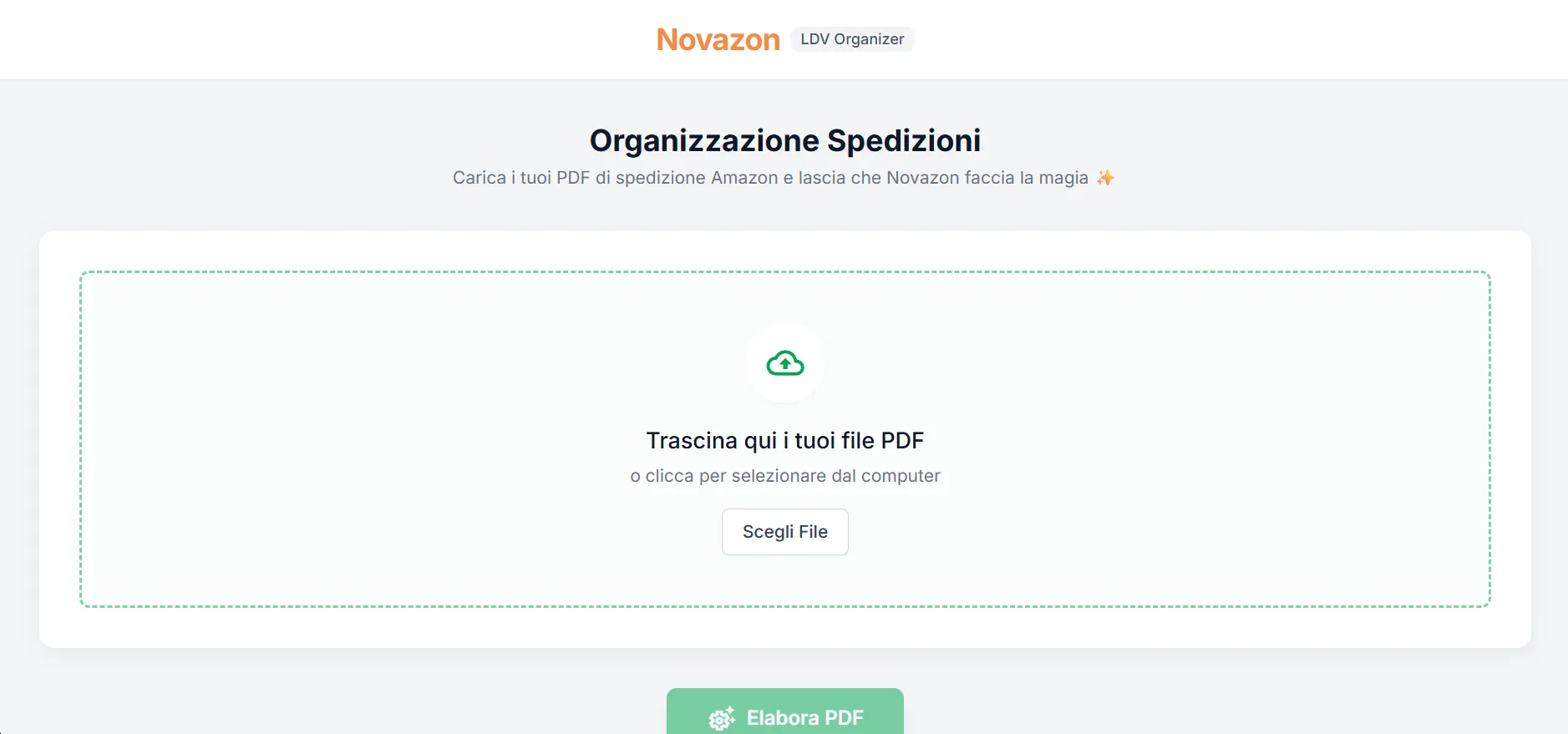
Every day, 2-4 hours of Novazon’s logistics team disappeared into thin air.
Not because of poor organization. Because of a process that didn’t have a solution yet.
The problem
Amazon generates a PDF for every shipment to its warehouses. They’re called Bills of Lading. The team would download them one by one, open each one, look for the destination, group them manually, then recreate summaries in Excel.
Every day. Dozens of documents. By hand.
The risk wasn’t just wasted time: a document in the wrong folder means a package shipped to the wrong warehouse. And on Amazon, logistics errors are expensive.
The solution
I built LDV Organizer, an internal web app that does in seconds what used to take hours.
The operator uploads PDFs with a drag-and-drop. The system reads them, identifies each shipment’s destination, separates products, and generates everything automatically: a PDF for each warehouse, documents separated by product, an Excel summary with quantities and destinations, and a ZIP archive ready for filing.
Zero configuration. Zero Excel spreadsheets open by mid-morning.
The hard part
Amazon’s PDFs aren’t uniform. They change format depending on the shipment type and marketplace. I built a three-level recognition system: first it looks for the warehouse code in standard format, then tries to extract it from the address, and if it still can’t find it, it flags the document for manual review instead of guessing.
Guessing, in logistics, is not an option.
The results
| Metric | Before | After |
|---|---|---|
| Processing time | 2-4 hours per day | A few seconds |
| Sorting errors | Frequent | Nearly eliminated |
| Operators needed | 1 dedicated | Anyone on the team |